FTTH / FTTx in New Hampshire
FTTH Contractor in New Hampshire: FTTx Construction
FTTH and FTTx construction for ISPs, co-ops, and towns covers several tasks. It includes feeder design, drops, multi-dwelling unit (MDU) wiring, splicing, and passive optical network (PON) activation testing with mapped proof.

Quick answer
Teams build feeder, distribution, drops, and in-unit wiring ready for service under this FTTH and FTTx construction scope. ISPs, co-ops, towns, and developers use it for subdivisions, mill buildings, and rural roads. Price tracks aerial versus buried footage, ledge, unit counts, and make-ready (pole preparation) findings. A subdivision sector often builds in two to four weeks.
Overview
Subdivisions, mill districts, and back roads each need activatable homes on schedule. Along the Merrimack Valley and the Seacoast, density and old brick buildings set the pace. Routes near Laconia, Keene, Lebanon, and Berlin stretch past ledge and till. We engineer gigabit passive optical network (GPON) and XGS-PON splits for local take rates. Feeder and distribution go by lashing or boring, and work sequences around mud, ice, and frost. Spare strands and optical margin keep upgrades simple.
Project manager Marlon Chandler (BICSI RCDD) sizes splitter ratios and optical budgets so GPON today moves to XGS-PON without rebuilds. Crews with 24/7 dispatch average 47 minutes to Merrimack Valley tickets and complete about 800 drops a month in Rochester and Somersworth. Splices average 0.03 dB, well under the 0.10 dB limit, backed by a 2-year workmanship warranty. Towns, co-ops, and developers get one schedule for design, permits, build, and closeout.
Town meeting votes and utility pole schedules shape FTTH timelines here. Our summary of New Hampshire broadband funding rules for builders outlines compliance steps. The review of high-level versus low-level outside-plant design outputs shows which drawings prevent rework in ledge country and winter frost.
Standards we build to
- TIA-526-7-A — single-mode insertion-loss testing for OS2 feeder, drop and PON legs
- TIA-568.3-D — acceptance limits for splice, connector and link loss
- Telcordia GR-771 — splice closure sealing for underground and aerial hubs
- NEC Article 770 — inside-building fiber pathways, firestopping and grounding
- TIA-606-C — labeling and administration for terminals, NIDs and ONT positions
How Do You Design PON Plant for Winter Reliability?
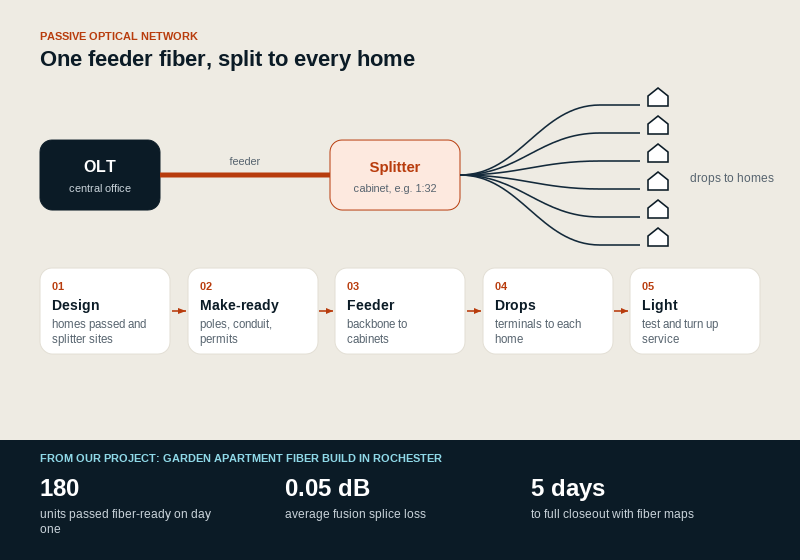
Design locks winter uptime before a shovel moves. A central office or remote OLT (optical line terminal) feeds hubs and cabinets, then hardened distribution follows streets and private roads. Splitter ratios, hub spots, and splice points match take rates, with spare strands and margin reserved for XGS-PON growth. Tight streets get compact terminals and microduct, while long rural feeders get snow-load slack and sealed closures.
Permits run parallel with design to protect start dates. We file NHDOT district permits for state routes and town road-opening approvals with select boards. Pole attachments move with Eversource, Unitil, Liberty, and New Hampshire Electric Cooperative, with make-ready gaps flagged early. Crews arrive with clear rights-of-way, and towns receive GIS maps, passing counts, and as-builts for operations and funding files.
What Happens From the Street to the ONT?
The last 200 feet decides activation success and winter tickets. We lash aerial drops to strand or bore buried drops in conduit below frost depth where ledge allows. Our crews steer under stone walls and septic fields. Each home ends at a sealed network interface device (NID) with slack, drip loop, grounding, and labels that survive plow-thrown snow. Crews photograph the NID and the optical network terminal (ONT) location and confirm address data for installers.
Apartment blocks move fast after a careful survey. We map risers, basements, and attic paths in mill conversions, workforce housing, and senior living before pulling cable. Indoor microduct, hallway molding, or armored riser goes in with firestopping at each penetration, then floor terminals feed discreet drops to every unit. Each ONT backplate is mounted, labeled, and tested, with panel schedules and unit matrices left for managers.
How Do Splicing, Testing, and Turn-Up Stay on Schedule?
Certified technicians fuse splitter inputs, feeder joints, and drop ends with core-alignment splicers in sealed closures. Each leg is certified with Tier 1 light-source and power-meter measurement for loss, length, and polarity, then Tier 2 OTDR traces pinpoint events. Single-mode spans run at 1310/1550 nm, with 1625 nm added on live PON legs, under TIA-526-7-A with limits from TIA-568.3-D. Reel tests and splitter-port records are filed before defects leave the closure. Field review by Miles Landry (FOA CFOT), September 2026, confirms results.
Streets turn up in waves so marketing moves before the whole town finishes. Feeder certification often closes in one sector while drops proceed in the next, with same-day rework before activation. Restoration leaves loam, seed, raked shoulders, and swept streets behind each crew. A 1x32 PON leg typically reads 15 to 22 dB end to end within a 28 dB budget. Closeout posts in three business days.
FTTH / FTTx in New Hampshire: what's different here
Ledge, frost, and narrow roads shape each plan. Shallow bedrock in Monadnock and White Mountain foothills forces boring or shallow armored paths. High water along the Merrimack and Connecticut Rivers calls for sealed closures and slack above flood lines. Historic districts limit trenching near stone foundations and granite curbing, and state routes need NHDOT district permits with town approvals and spring postings. We time drops around mud season, foliage on Routes 93, 16, and 101, and ski traffic. Share a route KMZ, address list, and unit counts; we return a build cost range, wave schedule, and assumptions in one business day.
Who hires us
Who we build FTTH / FTTx for
Hill-town subdivisions and long driveways raise drop costs fast. internet providers planning neighborhood rollouts hire us for FTTH construction that controls splices and activations.
Select boards face mud-season roads and town approvals on every mile. municipal leaders funding community fiber rely on us for FTTH construction with orderly splicing and records.
Garden-style complexes and historic mill conversions need discreet risers and drops. So apartment developers seeking bulk-ready service rely on us for FTTH construction that keeps units rentable.
ISPs & Telecom Carriers
Carrier-grade fiber-to-the-home (FTTH), middle-mile, and last-mile builds for ISPs and telecom carriers, with aerial, underground, splicing, and NOC-ready testing across New Hampshire.
Electric Utilities & Cooperatives
Utility fiber construction, all-dielectric self-supporting (ADSS), optical ground wire (OPGW) support, underground, and supervisory control and data acquisition (SCADA) links for electric utilities and cooperatives built for ice, wind, and granite ground.
Data Centers
High-density inside-plant, cross-connects, and diverse entrance fiber for colocation and enterprise halls, certified for low loss and polarity with usable records.
Government & Municipal Broadband
Open-access backbone, town-wide distribution, and transportation fiber for municipalities and agencies, from design and permits through testing and handoff records.
Benefits
Why owners pick us for FTTH / FTTx
Activation-Ready Addresses
Drops, splicing, and testing stay staffed to subdivision volume with verified addresses. Marketing, installers, and billing advance together from town to town without backlogs or repeat visits.
Ledge and Frost Drops
Long driveways, ledge, stone walls, and triple-deckers are routine. Buried depth below frost or correct aerial tension cuts winter faults and repeat visits across rural routes.
MDU Units That Pass First Visit
Labeled terminals, checked unit counts, photographed ONT spots, and budget-verified legs lift first-visit activation rates. Installers clear floors faster with fewer redispatches in dense housing.
One Partner Since 2005
Design, permitting, construction, and closeout run on one schedule across 38 cities and 10 counties. Fewer handoffs keep engineers, town offices, and crews aligned on each phase.

Process
Our FTTH / FTTx process
Walkout and PON Design
Teams verify addresses, pole and conduit paths, cabinet spots, and optical budgets. You receive a buildable scope, splice-point plan, and locked passing counts for approval before permitting.
Permitting and Pole Coordination
Staff file NHDOT and town permits plus attachment applications with make-ready sequencing. You receive weekly status notes, filed copies, and clear rights-of-way before crews mobilize.
Feeder and Distribution Build
Crews place strand, cable, conduit, cabinets, and terminals by sector with traffic control. You receive weekly footage totals, photo updates, and daily cleanup confirmation logs.
Drops and MDU Wiring
Techs land labeled NIDs, mount ONT backplates, and wire floors with tested legs. You receive unit matrices, address-tied photos, and panel schedules for managers and installers.
Splice, Test, and Turn-Up
Technicians splice, certify with Tier 1 and Tier 2 records, and correct defects fast. You receive .sor traces, optical loss test set (OLTS) tables, GIS maps, and activatable releases within three business days.
Proof
FTTH / FTTx projects we've delivered

Downtown Municipal Conduit Backbone in Concord
For Concord's broadband office, we designed and placed 22 miles of backbone and microduct through downtown and Penacook. The 288-count open-access plant passed testing and left Main Street brickwork intact.

Garden Apartment Fiber Build in Rochester
We delivered PON-ready fiber to 180 units across three buildings in Rochester, pairing provider-neutral distribution with clean telecom rooms for fast turn-up.
Learn more
Articles on FTTH / FTTx
Areas we serve
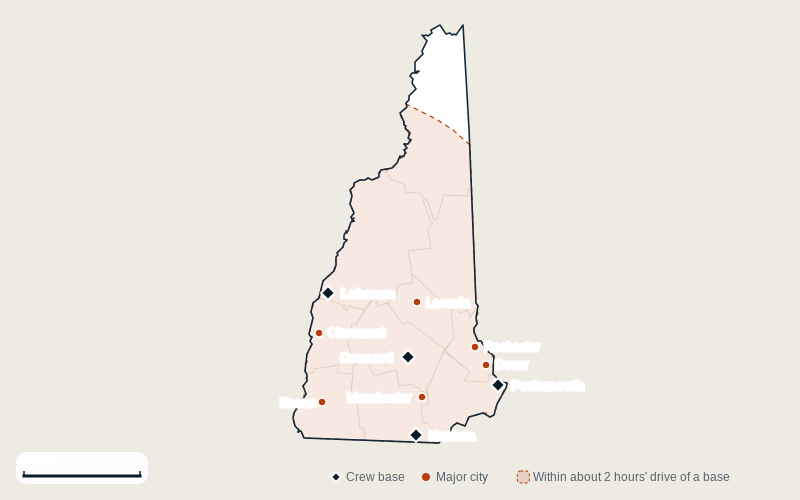
FTTH / FTTx in the major New Hampshire metros
How our crews handle FTTH / FTTx across town routes and ledge
FAQ
FTTH / FTTx FAQ
Compares FTTH terms, drop methods, PON basics and neighborhood buildout pacing.
What is the difference between FTTH, FTTP and FTTx?
FTTH means fiber to the home and FTTP means fiber to the premises — in practice the same single-family or business build. FTTx is the umbrella term that also covers fiber to the curb, building, or node where copper or coax finishes the run. We build true FTTH/FTTP with PON optics to the ONT, so each address gets dedicated fiber capacity rather than a shared legacy tail.
How is fiber run to a house (aerial vs buried drop)?
Most New Hampshire homes get either an aerial drop lashed to existing telephone strand from the pole or a buried drop in conduit from a handhole or terminal. Aerial is faster where pole access exists; buried is preferred for aesthetics, new subdivisions, and streets targeted for pole removal. Around the Lakes Region we often bore conduit on rocky lots or long shared driveways. That conduit protects the drop from frost, plows, and tree damage.
What is a PON / GPON network?
A passive optical network uses an unpowered splitter to share one feeder fiber among 16 to 64 homes. GPON is the common gigabit standard; XGS-PON adds 10-gig symmetric capacity over the same outside plant. Your OLT in the central office feeds splitters in cabinets or terminals, and each home’s ONT converts light to Ethernet. We engineer split ratios and light budgets so neighborhoods from Manchester to Berlin activate cleanly and can upgrade without rebuilding.
How long does an FTTH buildout take per neighborhood?
A typical 300- to 500-home neighborhood takes two to five weeks for backbone and drops. This timing applies once permits and make-ready are clear, plus splicing and testing. Make-ready, NHDOT or town permits, ledge, and mud-season road postings add the most time — often four to eight weeks upfront. We phase work so ISP installers can start activations in finished streets in places like Dover or Concord. Later streets are still under construction.
Do you work as a subcontractor to ISPs?
Yes. About half our FTTH work is as a production subcontractor to ISPs, prime contractors, and engineering firms. They need extra drops, splicing, or full distribution crews. We work under your specs and safety plan and attend your stand-ups. Ticketing and closeout formats stay yours as we scale from two-person drop crews to multi-crew builds. We also prime municipal and developer projects directly when you need a single turnkey partner.
Related services
Frequently paired with FTTH / FTTx
Fiber Network Design & Engineering
Towns and ISPs get buildable routes because engineering pairs field verification, make-ready, permits, and bid-ready GIS packages.
Aerial Fiber Construction
ISPs and co-ops receive storm-ready aerial spans that pass National Electrical Safety Code (NESC) inspection with documented sag, clearance, and OTDR proof.
Underground Fiber Construction
Businesses and carriers get permitted underground fiber with proven duct, splice-ready structures, and certified test results in one scope.

Start a project
Get a Fixed Fiber Price
Send drawings or route Google Earth map file (KMZ). Get itemized price, schedule window and exclusions within one business day.
Expect a planning estimate within one business day.