Data Center Cabling in New Hampshire
Data Center Fiber Cabling in New Hampshire
High-density trunking, single-mode (OS2) and laser-optimized multimode (OM4) distribution, plus clean power, grounding, and labeling for live server halls. Tested links arrive documented and ready for planned upgrades.

Quick answer
Data center structured cabling in New Hampshire covers MPO (multi-fiber push-on) trunks and OS2 and OM4 backbones. It covers MDF/IDF (main distribution frame/intermediate distribution frame) buildouts and Category 6A horizontal. Hospitals, campuses, colocation, and manufacturers use it for 100G and 400G growth. Most rooms take two to six weeks. Price follows port count, trunk length, room work, and night cutovers.
Overview
Hospitals, universities, colocation suites, and plants need inside plant that holds up at 100G and 400G without rework. We design and install OS2 and OM4 riser and plenum backbones, 12- and 24-fiber MPO trunks, cassettes, enclosures, ladder tray, trough, new racks, bonding, and grounding. Field supervisor Ruben Warner (FOA CFOS/S) sets polarity to match your optics. He keeps average splice loss at 0.02-0.05 dB, under the 0.10 dB limit before cutover. Last fall we built 864 LC ports and 48 MPO trunks for a Nashua hospital wing in five weeks with zero daytime outages.
You get Tier 1 optical loss test set (OLTS) insertion-loss results. Tier 2 optical time-domain reflectometer (OTDR) traces cover backbones with copper channels certified to the limit. Single-mode links are tested at 1310/1550 nm per TIA-526-7-A and multimode at 850/1300 nm per TIA-526-14-C. Results are judged against TIA-568.3-D limits for loss and length. Closeout brings .sor files with PDF reports, rack elevations, patch schedules, photos, and as-builts in PDF and CAD drawing (DWG). It arrives within five business days, backed by a 2-year workmanship warranty. Dispatch answers 24/7 for faults. You send floor plans, port counts, and optics list. A team returns a budgetary number, schedule window, and assumptions within one business day.
Dense racks punish poor polarity and bend loss. Our review of factory-terminated trunk cables versus site-built ends compares speed and test results. Then our primer on picking the right glass for link distances matches cable to optics and reach. It suits cold basement vaults and hot aisles.
Standards we build to
- TIA-568.3-D — optical fiber loss and length limits for acceptance
- Single-mode OLTS loss measurement follows TIA-526-7-A at 1310/1550 nm
- Measurement of multimode OLTS loss per TIA-526-14-C takes place at 850/1300 nm
- TIA-606-C — labeling and administration from panel to port
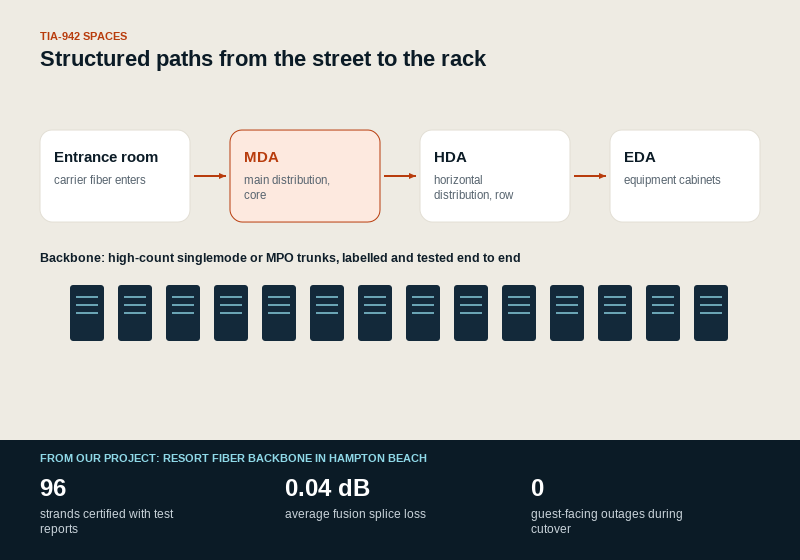
- TIA-942 — data center spaces, pathways, and redundancy grades
How do you build MPO backbones that carry 100G to 400G?
High-density halls run short on space, airflow, and time. We map transceivers first, then choose 8-, 12-, or 24-fiber MPO trunks. Then we choose cassette versus direct-mate and polarity to fit OM4 SR reach or OS2 duplex LR4. Pre-terminated trunks land where schedule is tight, while field-spliced pigtails serve odd lengths and low-loss needs. Every tray keeps bend radius, slack loops sit clear of doors, and labels follow TIA-606-C from panel to port.
For 800 meters of OS2 at 0.4 dB per km, fiber contributes 0.32 dB. Four splices at 0.05 dB plus four connector pairs at 0.30 dB bring the total near 1.72 dB, leaving margin. We verify each link with OLTS power measurement and OTDR traces, holding mated pairs under 0.75 dB maximum. RCDD Ellen Marsh stamps the design, and crews record 98% first-pass OTDR acceptance across New Hampshire jobs.
What does an MDF/IDF cleanup and build include?
Older mill and brick buildings hide crowded risers, shared electric rooms, and granite that fights new penetrations. We survey pathways, power, cooling and bonding. The setup adds racks, cabinets, ladder tray, fiber trough, busbars and vertical managers for hot- and cold-aisle flow. Dust containment, firestopping, and photo logs keep facilities and code officials satisfied during the work.
Copper work runs beside fiber without mixing paths. We place Category 6A for Wi-Fi access points, cameras, and PoE devices, holding copper channels to 100 meters with 90-meter permanent links. In Concord we reclaimed two IDFs in a clinical building. We replaced 140 tangled jumpers with 96 dressed OM4 and 6A drops and cut ticket time by half. NEC Article 770, TIA-607-D bonding, and NH State Building Code drive penetrations, grounding, and labeling on every floor.
How do you keep live data halls online during cutovers?
Live rooms stay up through phased moves with written rollback steps. We schedule night and maintenance-window work with IT, carriers, and managed providers. Then we stage redundant paths and guard adjacent racks with ESD (electrostatic discharge) controls and covers. Cleaning and scoping every end-face before mating avoids most failures and retests.
Closeout includes OLTS length and loss tables, OTDR .sor traces for backbone strands, and copper reports to the channel limit. You also receive updated elevations, patch schedules, test PDFs, and Google Earth map file (KMZ)/DWG as-builts that show routes, slack, and access points. Our 98% first-pass acceptance holds because marginal links are re-spliced, re-cleaned, and retested before handover, not noted as exceptions. Day-two support covers moves, adds, and faults with documented port history that speeds troubleshooting for your staff.
Data Center Cabling in New Hampshire: what's different here
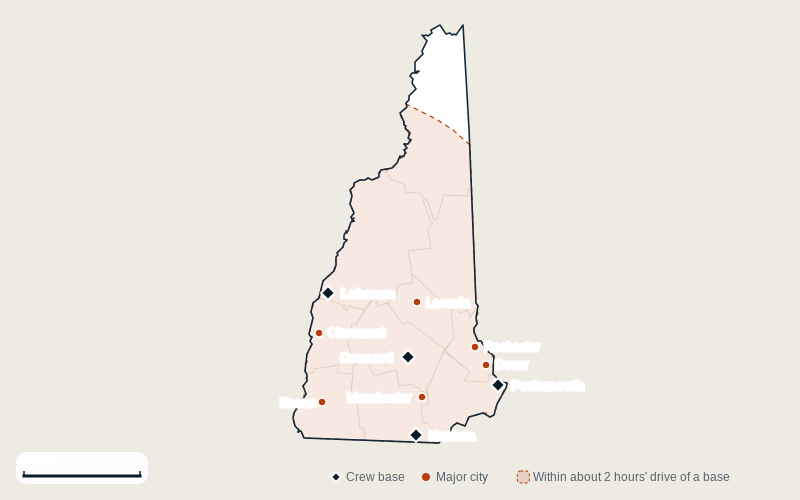
Granite ledge and old mill construction shape most New Hampshire inside-plant work. Manchester, Nashua, and Dover mills bring thick brick, tight risers, and limited grounding that force careful tray routes and busbar plans. Seacoast rooms face salt air and summer humidity, so enclosures, filtration, and stainless hardware matter more than inland. Lakes Region and North Country sites add deep cold, static, and ice-season access limits that push winter cutover planning. We coordinate around UNH Durham, Dartmouth Hanover, and Keene calendars, plus clinical windows in Concord, Manchester, and Lebanon to avoid downtime. Founded in Nashua in 2005, our team places 310+ miles of outside plant (OSP) fiber yearly. It holds 98% first-pass acceptance on tested links.
Who hires us
Who we build Data Center Cabling for
Lecture halls and labs add devices every semester. So university technology groups modernizing building networks hire us for data center and structured cabling with labeling and test files.
Patient towers mix copper, glass and wireless on floors. So clinic engineers supporting systems turn to us for data center and structured cabling with night work and dust control.
Warehouse expansions and refits stall when pathways fill early. So operations leaders outfitting work areas bring us in for data center and structured cabling that leaves room to grow.
ISPs & Telecom Carriers
Carrier-grade fiber-to-the-home (FTTH), middle-mile, and last-mile builds for ISPs and telecom carriers, with aerial, underground, splicing, and NOC-ready testing across New Hampshire.
Electric Utilities & Cooperatives
Utility fiber construction, all-dielectric self-supporting (ADSS), optical ground wire (OPGW) support, underground, and supervisory control and data acquisition (SCADA) links for electric utilities and cooperatives built for ice, wind, and granite ground.
Data Centers
High-density inside-plant, cross-connects, and diverse entrance fiber for colocation and enterprise halls, certified for low loss and polarity with usable records.
Government & Municipal Broadband
Open-access backbone, town-wide distribution, and transportation fiber for municipalities and agencies, from design and permits through testing and handoff records.
Benefits
Why owners pick us for Data Center Cabling
Headroom for faster optics
Low-loss splices and verified MPO polarity leave measured margin for 100G and 400G optics. New transceivers light without pulling new trunks in most rooms.
Neater rooms, faster fixes
Dressed trough, controlled slack, and panel-to-port labels cut locate time. They improve airflow around active gear in tight New Hampshire closets and halls for service teams.
Live-site control
Phased cutovers, night windows, and rollback plans kept a Nashua hospital wing online during 48 trunk migrations. No daytime outage occurred across five weeks for clinical staff.
Paperwork auditors accept
OLTS tables, OTDR traces, copper reports, and rack photos tie each port to a result. They support warranty review and capacity planning for IT and compliance teams.

Process
Our data Center Cabling process
Discovery and Pathway Survey
We walk distribution frames, risers, and tray routes and record counts, optics, power, and grounding. You receive photos, constraints, and a marked port plan within days.
Engineered Design
Designers produce rack layouts, trunk schedules, polarity maps, and loss budgets tied to your switch roadmap. You receive drawings and a priced scope for approval.
Staged Installation
Installers set racks, tray, and grounding, then pull, dress, splice, and label cable to bend and fill rules. You receive daily progress photos and open punch items.
Cutover and Certification
Technicians migrate circuits in windows, clean and scope faces, and test with OLTS, OTDR, and copper certifiers. You receive passing results nightly with failures fixed before morning.
Handover and Support
Closeout delivers .sor files, PDFs, as-builts, and patch records within five business days. You receive MAC (moves, adds, changes) help for quick moves and fault calls.
Proof
Data Center Cabling projects we've delivered

Data Hall Fiber Certification in Portsmouth
Data center operator at Pease Tradeport added 1,728 strands of OS2 and OM4 with diverse entrances. It hit 0.22 dB max MPO loss and zero tenant downtime.
Learn more
Articles on data center cabling
Areas we serve
Data Center Cabling in the major New Hampshire metros
How our crews handle Data Center Cabling across town routes and ledge
FAQ
Data Center Cabling FAQ
Details MPO use, trunk choices, MDF and IDF builds plus live-room work.
What is MPO/MTP fiber and why use it in New Hampshire data centers?
MPO/MTP is a multi-fiber connector that packs 8 to 24 fibers in one plug, ideal for high-density fiber and parallel optics. In Manchester and Nashua data suites it saves rack space and improves airflow. Pre-terminated trunks speed deployment. They provide a clean migration path from 10G to 100G, 400G and 800G without replacing backbone cable.
Pre-terminated trunks vs. field splicing — which is better?
Pre-terminated trunks are faster, factory-tested and ideal for tight maintenance windows and consistent polarity in new MDF/IDF builds. Field splicing with pigtails wins where pathways are congested, lengths are uncertain, or granite and mill construction force custom routing. We often combine both and verify every link with Tier 1 and Tier 2 testing.
Do you build MDF/IDF rooms from scratch?
Yes. We build complete telecom and server rooms including racks, cabinets, ladder tray, fiber trough, PDU coordination, grounding busbars, lighting, labeling and cable management. We also remediate overstuffed closets by removing abandoned cable, correcting fill ratios, adding proper grounding and documenting layouts for facilities and IT teams.
Can you work in a live data center or hospital without downtime?
Yes, most of our work is live-site. We survey dependencies, build parallel paths, and schedule night or low-census windows. Our team uses phased cutovers with rollback plans and coordinates with your IT staff and carriers. Dust control, ESD protection and continuous communication keep clinical systems, classes and production networks running during the project.
Do you install copper cabling too, or only fiber?
We install both as a full structured cabling contractor. Alongside singlemode and multimode fiber backbones we deploy Category 6A for workstations, Wi-Fi access points, cameras, access control and PoE lighting. Bundling copper and fiber under one contractor simplifies grounding, labeling, testing and warranty for New Hampshire offices, schools and healthcare facilities.
Related services
Frequently paired with Data Center Cabling
Fiber Optic Testing & OTDR Certification
Owners receive defensible acceptance proof because our crew certifies every strand with calibrated Tier 1 and Tier 2 testing.
Fiber Optic Installation
Our crews design and build single-mode and multimode outside plant and inside risers that test clean and stay online through winter.
Fiber Optic Splicing
Certified splicers fuse single-fiber and ribbon plant and verify each joint with bidirectional traces for steady winter performance.

Start a project
Get a Fixed Fiber Price
Send drawings or route Google Earth map file (KMZ). Get itemized price, schedule window and exclusions within one business day.
Expect a planning estimate within one business day.