24/7 restoration
Emergency Fiber Repair in New Hampshire, 24/7
A cut or storm-damaged cable gets 24/7 dispatch and precise fault location. It gets temporary light for priority circuits and permanent splicing verified with optical time-domain reflectometer (OTDR) traces and photo records.

Quick answer
Our 24/7 Emergency Fiber Restoration covers cuts, ice damage, and outages for ISPs, utilities, hospitals, towns, and enterprises. Crews isolate faults with OTDR and live-fiber identifiers, then restore priority strands fast. Permanent rebuild time and cost depend on fiber count, damage length, access, and pole or vault work.
Overview
A cut span returns to service in hours when crews arrive built for winter. Trailers carry core-alignment splicers, OTDRs, live-fiber identifiers, generators, pumps, and lighting for night work in subzero cold. Nor’easters, glaze ice, and freeze-thaw heaves snap aerial spans, flood vaults, and expose shallow cable over granite ledge. Field supervisor Elise Corbett (FOA CFOS/S) isolates faults to the meter and directs make-safe with power and traffic control.
Every call reaches a live dispatcher around the clock from our Nashua base. Average emergency dispatch in Merrimack Valley runs 47 minutes, with 24/7 rollout statewide for ISPs, hospitals, utilities, and towns. Crews stabilize priority strands with emergency restoration cable. They rebuild permanently with new closures, re-spliced 24- to 288-count loose-tube or ribbon cable, and re-hung spans. Last February crews restored a 144-count cut along I-93 in 9 hours, averaging 0.04 dB per splice and 98% first-pass OTDR acceptance.
A backhoe pull or plow snag needs a safe temporary fix first. Our outline of steps after a cable cut before permanent repair explains isolation and reroute. Also, our guide to fusion joining for fast permanent joints shows how crews close splices to acceptance values.
Budgeting this work? Our guide to fiber repair cost in New Hampshire details sourced planning ranges and what a complete quote should include.
Standards we build to
- TIA-568.3-D — fiber loss limits and mated-pair 0.75 dB max for acceptance
- The single-mode OLTS insertion-loss method references TIA-526-7-A at 1310/1550 nm
- Telcordia GR-771 — splice closure sealing and re-entry for rebuilds
- National Electrical Safety Code (NESC) ANSI C2 — aerial clearances, loading, and grounding after storms
- OSHA 29 CFR 1926 Subpart P/V — excavation safety and power-line separation
How Do Crews Make It Safe and Find the Fault?
Crews bypass damaged sections only after the site is safe for traffic and power. Technicians coordinate with Eversource or town police for lane control. They test for energized attachments, pump flooded handholes, and set lights and heat for night splicing. They shoot OTDR traces from both ends and check live strands with fiber identifiers. Exact break distance gets marked before any cable is opened.
Downed poles on Route 101, plow strikes near Laconia lots, and ice-loaded spans outside Berlin each need different access and spares. You receive NOC (network operations center) updates with OTDR distance, photos, and a realistic ETA for temporary light. Temporary jump closures and armored bypass cable carry 911, hospital, and utility circuits. Permanent parts are staged, so priority traffic does not wait for daylight.
What Drives Emergency Cost and Repair Time?
Costs follow damage length, fiber count, and access constraints more than mileage alone. A 12-count lateral cut with slack nearby splices in hours, while a 288-count ribbon trunk across a washed-outSpan needs multiple closures, new poles, and traffic details. You see line items itemized before work proceeds. They include night rates, horizontal directional drilling (HDD) under ledge or streams, NHDOT permits, and pole-owner inspections.
Access drives schedule in mud season and deep snow when White Mountain grades and back roads need 4x4 and tracked support. Vault pumping, de-icing, and generator heat add time but protect splice quality. Crews complete about 2,400 fusion splices monthly, so splicers, test gear, and restoration cable are already loaded when your call lands. You get a temporary-light ETA on the first call and a fixed permanent-repair window before crews leave site.
Emergency Restoration in New Hampshire: what's different here
Outages here track ice and granite more than wind alone. Wet snow loads spans from Keene to the Seacoast and glaze coats ridges toward Mount Washington. Frost heaves shallow burial over ledge, and spring melt washes Saco, Merrimack and Connecticut crossings. Tourist traffic on I-93, Route 16, and the Kancamagus complicates lane closures, while NHDOT districts and town road agents control emergency access. Crews stage for Everett Turnpike density and remote Coos County townships alike. You call (603) 555-1131 first with damage location, photos and fiber count. Then you will get a live answer, a temporary-light ETA and a permanent-repair window before crews clear site.
When to call
When to call us
If you see these signs, call now — crews answer through winter nights too.
Ice Storm and Nor'easter Aerial Failures
Heavy glaze ice and wet snow overload all-dielectric self-supporting (ADSS) and lashed spans in the Whites and Lakes Region. Snapping poles slap fibers into power. We clear hazards with utility crews, set interim spans, and re-sag to NESC ice-loading clearance before permanent replacement.
Logging and Tree-Clearing Take-Downs
Logging skidders and rural land clearing in Coos, Grafton, and Carroll counties snag low guys. They pull down backbone lashed to mature timber lines. We patrol with OTDR distance faults, re-hang strand, and armor or reroute spans away from active harvest blocks.
Plow and Mill-and-Pave Cuts
Snowplows, sidewalk machines, and mill-and-pave contractors shave shallow drops and handhole lids in Portsmouth, Dover, and Manchester. We expose the break, blow new microcable or pull innerduct. Crews reseal vaults flush for plows and re-certify loss for the owner the same shift.
Spring Flood and River Scour
Spring snowmelt swells the Merrimack, Connecticut, and Saco rivers, undermining banks, floating vaults, and scouring HDD river crossings. We dewater chambers, replace waterlogged closures, re-rack slack above flood lines, and add armored crossings permitted through NHDOT and DES wetlands rules.
Third-Party Dig-Ins on Village Mains
Fence, deck, and drainage contractors working without fresh Dig Safe tickets nick village distribution in Derry, Rochester, and Keene. We tone and pothole the hit. Then we place mid-span closures or new vault segments, splice ribbon or loose-tube, and provide OTDR proof for damage claims.
Tourist-Season Construction Cuts
Tourist-season construction around Hampton Beach, North Conway, and Laconia severs laterals during crane sets, tent staking, and parking-lot rebuilds. We provide standby locators during events, reroute on spare strands to keep POS and lodging online, then permanently rebury after the season rush.
Statewide response
Restoration across New Hampshire
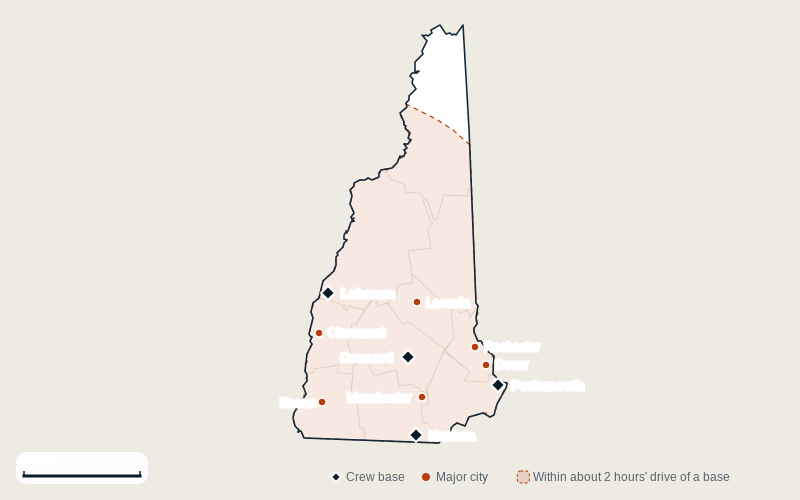
When a nor'easter snaps Seacoast spans, a logger drops a tree on Grafton County backbone. A mill-and-pave crew severs a Nashua lateral. Manchester dispatch answers around the clock. GPS-tracked splice trailers and HDD support stage in Manchester, Concord, and Littleton. I-93, Route 16, and Route 101 corridors keep drive times under three hours to most cuts, even in whiteout detours. Direct lines ring to a live supervisor, not a call center, with Eversource and NHEC coordination built in.
An on-call project manager triages by impact with hospitals, 911, schools, and carrier backhaul first. The manager then rolls a locator, lineman, and splicer together to stabilize, reroute on spare fibers, and place interim spans. Permanent lashing, re-burial, OTDR proof, and updated as-builts follow within days, with photo documentation utilities and BEA-funded owners require for reimbursement. We stay until Tier 1 loss passes across Coos winters.
Who hires us
Customers we serve with Emergency Restoration
Nor'easters snap spans and drop trees across rights-of-way. line departments restoring storm-damaged routes hire us for 24/7 emergency fiber restoration with round-the-clock splicing.
Admissions cannot pause for a cut lateral. emergency departments relying on live records call our crews for 24/7 emergency fiber restoration with fast isolation and interim splices.
I-93 cameras and toll readers lose visibility when links fail. So highway crews maintaining roadside communications call our crews for 24/7 emergency fiber restoration that clears faults quickly.
ISPs & Telecom Carriers
Carrier-grade fiber-to-the-home (FTTH), middle-mile, and last-mile builds for ISPs and telecom carriers, with aerial, underground, splicing, and NOC-ready testing across New Hampshire.
Electric Utilities & Cooperatives
Utility fiber construction, all-dielectric self-supporting (ADSS), optical ground wire (OPGW) support, underground, and supervisory control and data acquisition (SCADA) links for electric utilities and cooperatives built for ice, wind, and granite ground.
Data Centers
High-density inside-plant, cross-connects, and diverse entrance fiber for colocation and enterprise halls, certified for low loss and polarity with usable records.
Government & Municipal Broadband
Open-access backbone, town-wide distribution, and transportation fiber for municipalities and agencies, from design and permits through testing and handoff records.
Benefits
What sets our Emergency Restoration crews apart
Winter-Ready Reach
Trailers with heat, light, pumps, and 4x4 access work ridge routes and urban corridors alike. Night splicing holds quality in subzero cold and wet snow.
Stable Temporary Light
Emergency bypass cable and jump closures return 911, clinical, and carrier circuits fast. Documented jump splices prevent forgotten weak points before permanent rebuild.
Verified Low-Loss Splicing
Core-alignment splicing with optical loss test set (OLTS) and OTDR proof restores full capacity on single-mode and ribbon plant. Hospitals and ISPs return to design budgets, not fragile patches.
Fewer Repeat Outages
Re-grounded armor, corrected sag, deeper burial, and photo records address shallow ledge, flood crossings, and overloaded poles common across the state.

Process
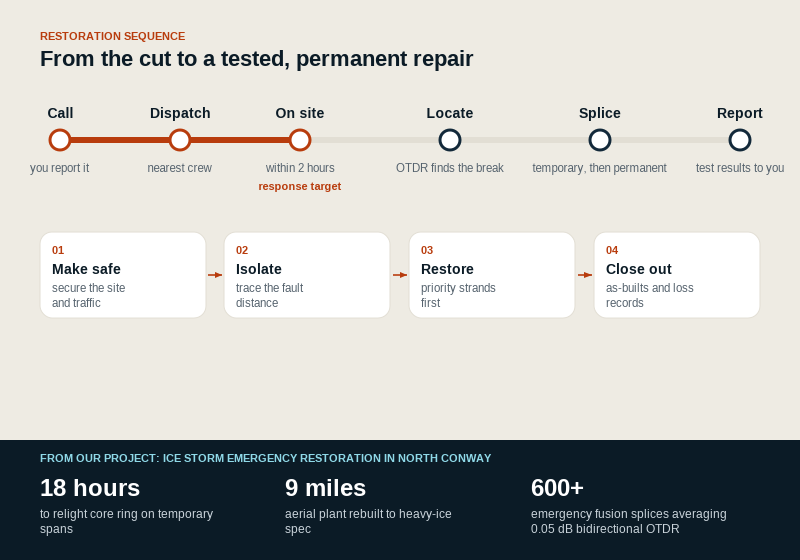
How restoration runs
Call and Triage
Your call reaches a Manchester supervisor day or night. He logs OTDR alarms, outage footprint, and site hazards. Then he prioritizes life-safety circuits, and dispatches locator, lineman, and splicer with ETA and utility notifications.
Stabilize and Temporary Relight
Crews make the site safe with traffic control and Eversource coordination and expose the cut. They fuse emergency jumpers or mechanical splices to restore hospitals, 911, and backhaul on spare fibers within hours.
Permanent Repair and Testing
We replace damaged cable sections, re-lash or re-pull duct, and dress new closures. Then we prove every strand with bi-directional OTDR and OLTS so loss meets budget and manufacturer warranty.
Closeout and Hardening
You receive updated splice maps, GPS as-builts, and test PDFs for public utility commission (PUC) or BEA files. They include recommendations like deeper burial, snowplow-proof vaults, or diverse routing to prevent repeat failures.
Proof
Emergency Restoration projects we've delivered
Learn more
Articles on emergency restoration
Areas we serve
Emergency Restoration in the major New Hampshire metros
How our crews handle Emergency Restoration across town routes and ledge
FAQ
Emergency Restoration FAQ
Outlines round-the-clock response, arrival pacing, fault locating and repair types.
Do you offer 24/7 fiber repair in New Hampshire?
Yes. We answer around the clock every day, including holidays and major storms. Whether it is a construction cut in Nashua, ice-loaded spans in the Lakes Region or a flooded vault on the Seacoast, our on-call splicers mobilize with trailers, test gear and restoration cable to stabilize service and then complete permanent repairs statewide.
How fast can a crew arrive after a fiber cut?
Response depends on distance, road conditions and storm load. We dispatch immediately and stage from the Merrimack Valley and central corridors. That gives fast coverage of Manchester, Concord, Nashua and Portsmouth. Remote White Mountain and North Country sites take longer in snow or mud season. You always receive an honest ETA and progress updates.
How do you find where fiber is broken?
We review route maps and recent OTDR baselines. Our crews shoot OTDR traces from one or both ends to measure distance to the break or high-loss event. Visual fault locators, live-fiber identifiers and mid-span inspections confirm the exact manhole, vault, pole span or bore. Damage occurred there even when cable looks intact from the surface.
What separates a temporary fiber repair from a permanent repair?
Temporary restoration uses emergency cable and quick closures to bring priority circuits up within hours during unsafe or storm-active conditions. Permanent repair replaces damaged sections, re-splices all fibers to design loss, rebuilds closures and supports, re-tests everything, and updates records. Temporary fixes should always be followed by a scheduled permanent rebuild.
Do you offer maintenance contracts or standby for storms?
Yes. ISPs, utilities, towns, hospitals and enterprises can retain priority dispatch, pre-loaded spares, updated route documentation and seasonal inspections. During ice and nor’easter season we pre-stage crews and monitor forecasts along critical corridors. This shortens restoration time and simplifies budgeting compared to time-and-materials emergency calls.
Related services
Frequently paired with Emergency Restoration
Fiber Optic Splicing
Certified splicers fuse single-fiber and ribbon plant and verify each joint with bidirectional traces for steady winter performance.
Fiber Optic Testing & OTDR Certification
Owners receive defensible acceptance proof because our crew certifies every strand with calibrated Tier 1 and Tier 2 testing.
Aerial Fiber Construction
ISPs and co-ops receive storm-ready aerial spans that pass NESC inspection with documented sag, clearance, and OTDR proof.

24/7 restoration
Restore Cut Fiber Fast
Call (603) 555-1131 first. Dispatcher answers 24/7 and stages splicers for Merrimack Valley in under an hour.
Service returns on a temporary splice, then permanent repair follows.