Testing & OTDR Certification in New Hampshire
Fiber Optic Testing Services & OTDR Certification in New Hampshire
Optical time-domain reflectometer (OTDR) testing and Tier 1 certification prove plant meets spec before retainage releases. We measure single-mode and multimode links with calibrated instruments and deliver signed acceptance reports.

Quick answer
This service provides Tier 1 insertion-loss testing with an optical loss test set (OLTS). Tier 2 extended testing adds bidirectional OTDR traces for single-mode and multimode plant. Carriers, towns, hospitals, and data centers use it before acceptance. Most jobs finish in one to three site days, with price driven by strand count, access conditions, and reporting depth.
Overview
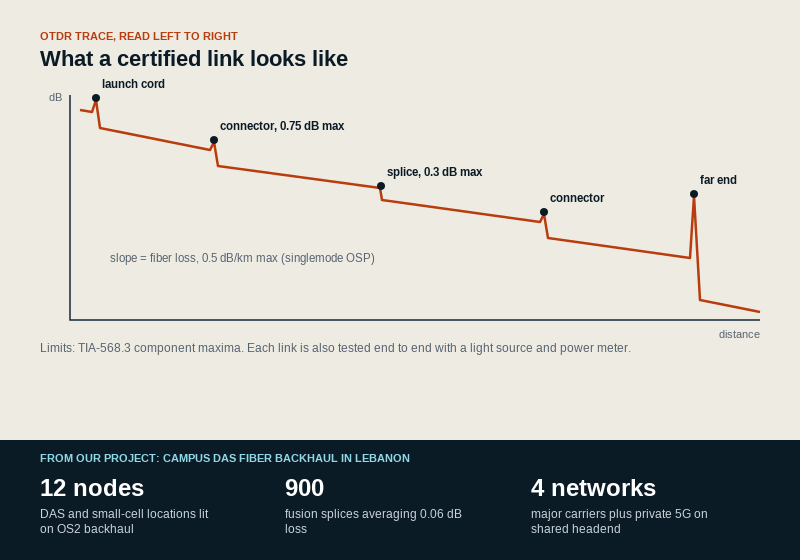
You receive a signed pass/fail record that carriers, manufacturers, and grant reviewers across New Hampshire accept without asking for retests. We measure Tier 1 insertion loss with calibrated sources and meters. Tier 2 OTDR traces follow shot from both ends with launch and tail cords. Single-mode OS2 is checked at 1310 and 1550 nanometers per TIA-526-7-A, multimode OM3/OM4 at 850 and 1300 nanometers per TIA-526-14-C, against TIA-568.3-D limits. We hold fusion splices to 0.10 dB or less, typically 0.02 to 0.05 dB. A Concord hospital riser improved from 0.81 dB to 0.18 dB after cleaning.
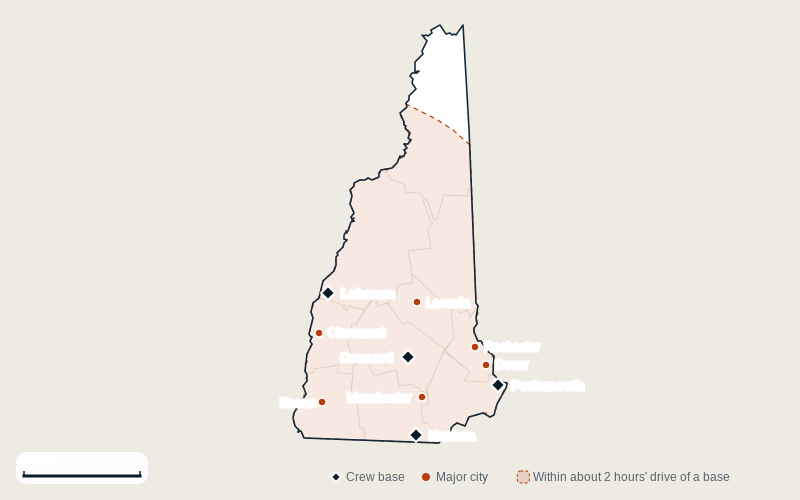
We test new builds, fault calls, and plant installed by others for ISPs, towns, and owners across Hillsborough, Rockingham, Merrimack, Strafford, and the northern counties. Field supervisor Dawn Hartman (FOA CFOS/S) averages bidirectional traces on site to remove gainer errors and flag reflectance failures. That process caught a stressed bend in a Nashua mill riser and a water-damaged splice north of Laconia before either caused an outage. You receive .sor files plus a PDF report, splice maps, and endface grades. A punch list with photos and GPS arrives within three business days.
Bid documents often mix loss, length, and trace requirements. Our guide to reflectometer traces versus basic loss and length checks sorts Tier 1 and Tier 2 work. Also our overview of choosing between single-mode and multimode glass helps match cable to distance and optics in cold climates.
Budgeting this work? We keep sourced planning ranges in our guide to fiber testing and certification cost in New Hampshire. We clarify what a complete quote should list.
Once a link is already misbehaving, we want facts. Our page on high fiber loss covers how we isolate the cause on a test trace and when it becomes an emergency.
If a link is already misbehaving, see our page on dirty fiber connectors. We confirm the cause on a test trace and explain when it becomes an emergency.
Standards we build to
- TIA-526-7-A — single-mode OLTS loss measurement on OS2 at 1310/1550 nm
- TIA-526-14-C — multimode OLTS loss measurement on OM3/OM4 at 850/1300 nm
- TIA-568.3-D — pass/fail limits for splice, connector, and cable loss
- IEC 61300-3-35 — endface cleanliness grading from microscope images
- TIA-606-C — labeling and administration for as-tested maps and panels
Need an Independent Check on Another Contractor's Plant?
General contractors need a neutral witness before retainage releases. We audit fiber-to-the-home (FTTH) drops in Dover and Rochester subdivisions. Then we audit campus rings in Lebanon and Keene and public-safety laterals around Manchester with no role in the build. Passive optical network (PON) splits are verified by port, with splitter loss and reflectance checked against manufacturer sheets. Counts, addresses, and closure locations are confirmed in the field.
Each audit closes with a bound acceptance packet your installer can act on immediately. Tables list OLTS loss, OTDR distance to each event, endface grades, and calibration dates for the meters and platforms used. Failures are photographed, GPS-tagged, and ranked by effect on the optical budget so critical splices clear before payout. You keep launch-cord references, .sor files, and Google Earth map file (KMZ) maps that tie each result to a handhole or terminal.
What Does Certification Include on Each Link?
Every link gets a full loss budget before testing starts. We calculate fiber kilometers times dB per kilometer, plus 0.10 dB per fusion splice and 0.75 dB per mated pair, with margin noted. One 8.4-kilometer OS2 lateral with six splices and four pairs budgets at 6.96 dB at 1310 nm. It must test below that plus margin. OLTS readings that exceed budget trigger cleaning, re-splicing, or bend correction before OTDR work continues.
Multimode legs follow a different rule set than single-mode plant. We test OM3 and OM4 at 850 and 1300 nanometers. Then we hold cable to 3.0 dB per kilometer at 850 nm and pairs to 0.75 dB maximum. Tier 2 adds bidirectional OTDR event maps, reflectance values, and inspection grades that manufacturers require for system warranties. Coherent and long-haul spans can add dispersion and polarization-mode checks where capacity plans demand it.
How Do You Find Faults on Live Networks?
Live networks need answers without added outages. We test lit single-mode with filtered 1625-nanometer OTDR ports that read through splitters while customer traffic stays up. Dark strands are shot at 1310 and 1550 nanometers from both ends. Distance calibration uses the cable index for accurate dig marks. Dirty jumpers, cracked bulkheads, and tight bends show distinct reflectance, so the fix starts at the right closure.
After the site visit you get plain findings instead of raw dumps. We rank faults by loss effect, attach photos and OTDR screenshots, and mark GPS coordinates for the repair crew. Founded in Nashua in 2005, our team completes 2,400-plus fusion splices monthly with a 98% first-pass OTDR acceptance rate. Repeat failures trigger a recommendation for replacement closures, reroutes, or added slack storage before winter.
Testing & OTDR Certification in New Hampshire: what's different here
Across New Hampshire, granite ledge and freeze-thaw shift loss seasonally, so winter baselines matter. White Mountain routes run long between access points with snow-covered handholes, which demands calibrated distance and GPS event tags. Moisture in older splice cases and mixed-vintage mill retrofits around former mill districts create reflectance that bidirectional averaging must resolve. Town roads post spring load limits while state routes need NHDOT district permits and evening traffic control in congested corridors. We format results for pole owners and broadband-office reviewers to support leases and public funds. Send fiber counts, site addresses, and any prior traces to receive a fixed test plan, crew window, and assumptions within one business day.
Who hires us
Customers we serve with Testing & OTDR Certification
Acceptance packages stall without clean traces and loss numbers. So carriers needing proof for new segments hire us for fiber optic testing and certification with organized results.
Uptime audits flag every dirty connector and bent jumper. So operations teams validating data hall links turn to us for fiber optic testing and certification before customer handoff.
Grant-funded builds require proof every mile performs. town broadband committees documenting new plant call our crews for fiber optic testing and certification with clear acceptance reports.
ISPs & Telecom Carriers
Carrier-grade fiber-to-the-home (FTTH), middle-mile, and last-mile builds for ISPs and telecom carriers, with aerial, underground, splicing, and NOC-ready testing across New Hampshire.
Electric Utilities & Cooperatives
Utility fiber construction, all-dielectric self-supporting (ADSS), optical ground wire (OPGW) support, underground, and supervisory control and data acquisition (SCADA) links for electric utilities and cooperatives built for ice, wind, and granite ground.
Data Centers
High-density inside-plant, cross-connects, and diverse entrance fiber for colocation and enterprise halls, certified for low loss and polarity with usable records.
Government & Municipal Broadband
Open-access backbone, town-wide distribution, and transportation fiber for municipalities and agencies, from design and permits through testing and handoff records.
Benefits
What sets our Testing & OTDR Certification crews apart
Warranty and Grant Acceptance
Manufacturers, carriers, and broadband-office reviewers accept our packets without retests. Limits, references, and calibrations are shown, which shortens closeout for town laterals and middle-mile spans.
Finds the Real Fault Fast
Distance, reflectance, and loss signatures separate a cracked bulkhead in a downtown office from a crushed duct or wet closure. Crews dig once and fix the correct span.
Protects Dark-Fiber Buyers
Independent length, loss, and splice proof stops overpayment on indefeasible rights of use and town laterals. It shows impaired strands before any money changes hands.
Lowers Lifetime Maintenance
Correct cleaning, torque, bend radius, and slack storage are recorded at day one. That record cuts winter failures during ice, flooding, and freeze-thaw across exposed rural northern routes.

Process
Our testing & OTDR Certification process
Define Acceptance Criteria
You receive a one-page test plan listing TIA limits, wavelengths, sample counts, and OTDR coverage for approval. We schedule site time and access needs after approval.
Clean and Inspect
You receive scoped images for every connector. Fails get cleaned or replaced first, so Tier 1 numbers reflect cable performance instead of dust, dirt, or damage.
Test Tier 1 Then Tier 2
You receive dated OLTS tables for total loss, length, and polarity. OTDR traces with launch and tail cords expose hidden connectors and events.
Analyze Bidirectionally
You receive averaged results with gainer artifacts removed. True splice values appear listed by distance, and coherent routes stay flagged for added characterization where needed for capacity.
Report and Remediate
You receive a signed PDF with .sor files, maps, and a ranked punch list. Retests of every fix continue until each link passes for warranty filing.
Proof
Testing & OTDR Certification projects we've delivered

Campus DAS Fiber Backhaul in Lebanon
For a private university group in Lebanon, we built single-mode (OS2) backhaul. It reaches 12 distributed antenna system (DAS) and small-cell nodes across the Upper Valley complex. Signal gaps closed in halls, garages, and labs with headroom for two more carriers.
Areas we serve
Testing & OTDR Certification in the major New Hampshire metros
Crews, winter conditions and scope where we run Testing & OTDR Certification most
FAQ
Testing & OTDR Certification FAQ
Defines OTDR, compares OLTS, clarifies Tier 1 and Tier 2 plus bidirectional needs.
What is OTDR testing?
An OTDR injects light pulses and measures backscatter to map distance, splices, connectors, bends, and breaks along a fiber. It shows where events occur and their reflectance and loss. For New Hampshire acceptance we pair OTDR with OLTS and inspection, testing bidirectionally on single-mode plant to produce true splice averages.
What's the difference between OTDR and OLTS?
OLTS measures total end-to-end loss like the network electronics see it, which determines pass/fail against TIA limits. OTDR shows where that loss occurs along the route. Acceptance and warranty typically require both — OLTS for the official loss number and OTDR to prove workmanship and locate fixable defects.
What are Tier 1 and Tier 2 fiber tests?
Tier 1 is OLTS insertion-loss, length, and polarity testing for overall compliance. Tier 2 adds OTDR traces to document individual splices and connectors. Together they satisfy most carrier and manufacturer warranty requirements. We deliver both in one visit with references, launch cords, and bidirectional averaging on single-mode links.
Do I need bidirectional testing?
Yes for single-mode acceptance. Apparent OTDR splice gainers and exaggerated losses occur because fibers differ slightly. Averaging traces shot from both ends yields the true value and is required by most carriers. We shoot bidirectionally on backbone and FTTH feeder fibers and include averaged event tables in your report.
What does a fiber certification report include?
You receive OLTS and OTDR files, bidirectional averages, endface photos with IEC grades, loss-budget comparisons, equipment calibration dates, as-tested maps, and a signed pass/fail summary. Defects include photos, OTDR distance, GPS, and recommended fixes. The packet supports carrier acceptance, warranty filing, and municipal grant closeout.
Related services
Frequently paired with Testing & OTDR Certification
Fiber Optic Splicing
Certified splicers fuse single-fiber and ribbon plant and verify each joint with bidirectional traces for steady winter performance.
Fiber Optic Installation
Our crews design and build single-mode and multimode outside plant and inside risers that test clean and stay online through winter.
Data Center & Structured Cabling
Our team builds tested high-density backbones and neat distribution rooms. Data halls stay ready for 100G and 400G growth.

Start a project
Get a Fixed Fiber Price
Send drawings or route Google Earth map file (KMZ). Get itemized price, schedule window and exclusions within one business day.
Expect a planning estimate within one business day.