Underground Construction in New Hampshire
Underground Fiber Installation in New Hampshire
Directional boring, trenching, and microtrenching place high-density polyethylene (HDPE) conduit and handholes. They place high-count cable tested with optical time-domain reflectometer (OTDR) and restored to town and state spec. That work covers ISP, utility, municipal, campus, and data-center routes.

Quick answer
Underground fiber construction here means permitted boring, trenching, duct, structures, and cable placement for ISP, municipal, and campus builds. Typical jobs run two to six weeks; price follows footage, rock, dewatering, and restoration. You get proven duct, spliced strands, Tier 1 and OTDR proof, and mapped as-builts.
Overview
You need duct and fiber under pavement, rivers, and lawns without failed inspections or repeat digs. We place 1.25-inch to 4-inch HDPE conduit by horizontal directional drilling (HDD), open trench, plow, and microtrench. Then we set handholes and vaults on compacted stone. Shallow granite, cobble till, and 4-foot frost north of Concord force pilot bores, vacuum potholing, and rock hammering on most routes. Last fall a 2,800-foot Merrimack Valley lateral crossed ledge and high water with zero hits, and every duct passed mandrel proof before cable.
Your scope runs from Dig Safe 811 tickets to pavement patches and test files in one contract. We mandrel and pressure-test each duct. Crews pull or jet-blow 48- to 864-count cable with tension and pressure control. They fusion-splice to 0.10 dB average or better. Single-mode links pass Tier 1 optical loss test set (OLTS) testing per TIA-526-7-A at 1310/1550 nm plus OTDR Tier 2 traces. Field supervisor Dawn Hartman (FOA CFOS/S) signs each result. Founded in Nashua in 2005, NH Contractor License #NH-889348 covers Bonded & insured work. It carries a 2-year workmanship warranty and 310+ miles placed yearly at 98% first-pass acceptance.
Ledge and high water tables decide the digging method more than distance does. Our comparison of trenching choices for rocky and frozen ground weighs access and repair. Also our overview of buried versus pole-mounted cable tradeoffs helps select routes that survive plows and ice year after year.
Budgeting this work? Our summary of directional boring cost per foot in New Hampshire provides sourced planning ranges. We clarify what a complete quote should include.
Standards we build to
- OSHA 29 CFR 1926 Subpart P — governs trench depth, sloping, shoring, and competent-person inspection
- National Electrical Safety Code (NESC) ANSI C2 plus NHDOT accommodation — governs cover depth, separation, and encasement at road crossings
- TIA-758-B plus Telcordia GR-20 — governs customer outside-plant (OSP) pathways, conduit, and cable placement practice
- MUTCD plus NHDOT work-zone rules — governs signs, channelization, and pedestrian control around excavations
- TIA-526-7-A plus TIA-568.3-D — governs single-mode loss testing and link acceptance limits
How do you bore under roads, rivers, and ledge without open cuts?
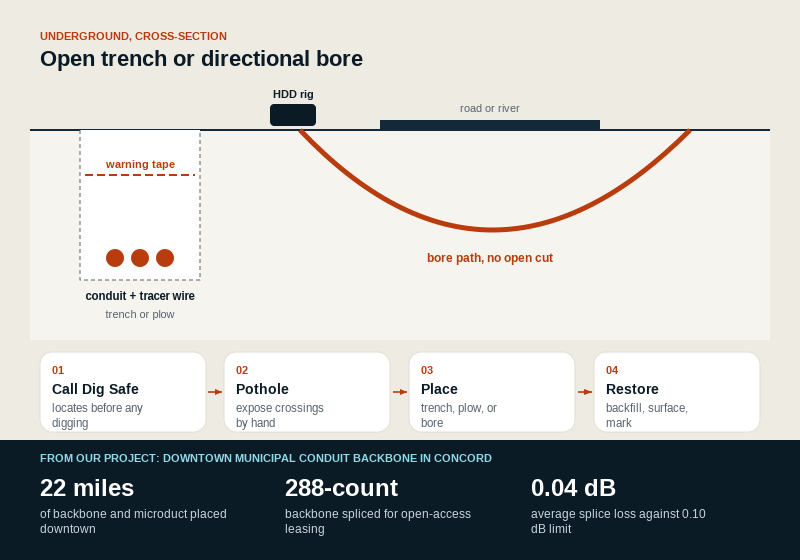
Pilot bores steer under state highways, rail, driveways, and rivers where trenching is banned. Compact rigs track depth and pitch and mix bentonite for cobble and fractured rock. They ream to size for one to four HDPE ducts and pull back conduit with tracer wire and mule tape. Shots run 200 feet for services to 1,200 feet for river crossings permitted through NHDOT districts. Ledge teeth and hole openers handle till that stops smaller machines.
City work needs tighter control. Crews vacuum-excavate every crossing in downtown streets and hospital lots, hold clearance from gas and water, and log depth and location for GIS. Each conduit is mandreled, capped, and proven with pull tape before blowing. Proven pathways cut re-drills after paving. Project files close within five business days with logs, photos, and duct maps.
What conduit, structures, and cable make up the underground system?
Laterals use SDR-11 HDPE with innerduct, concrete encasement at road crossings, and tracer for locates. Polymer or precast handholes sit on six inches of stone. They are cored for duct entries, racked for 50 feet of slack, and sealed against spring melt. Snowplow markers and locking lids protect plant in plow zones from the Lakes Region to the Seacoast. Grounding and drain stone go in where water tables surge.
Cable goes in by pulling short runs and jet-blowing long fills with air and lubricant. We place 48- to 864-count OS2 loose-tube and armored cable without over-tension. Then we dress slack, ground armor, and label ducts and closures per TIA-606-C. A 144-count build for a Rochester school averaged 0.04 dB per splice. It passed Tier 1 inside its calculated loss budget with .sor files delivered.
When does microtrenching work, and how is pavement left?
Microtrenching fits straight urban blocks with sound pavement where city permits allow narrow slots. We saw-cut 1- to 2-inch slots, set microduct, and seal with hot rubber or cementitious grout rated for frost heave and plow shear. Where brick, thin pavement, or moratorium streets rule it out, we switch to HDD or trench and note the change for approval. That call avoids rejected streets and voided warranties.
Restoration decides reputation. Backfill compacts in lifts with density tests, and lawns get loam and seed. Granite curb resets plumb, and asphalt patches meet town spec with butt joints. Sidewalks pour full-panel and shoulders regrade after mud season. Before-and-after photos and KMZ/DWG/PDF as-builts with depths and coordinates close every job for public works review.
Underground Construction in New Hampshire: what's different here
Granite changes everything in this state. Southern counties offer loam over till that bores cleanly. Monadnock, Lakes and North Country routes hit shallow bedrock, boulders and high water near rivers. NHDOT districts control depth, encasement, and patch specs on routes 101, 16, and 125, and towns guard curb, brick, and moratorium streets. Spring postings close town roads to heavy rigs and frost stops trenching north of Concord. We sequence HDD for summer-fall windows, stage spoil off narrow streets, and warrant patches through one freeze-thaw. Send a route KMZ, address list, or plan set and you get a budgetary number, schedule window, and assumptions within one business day.
Who hires us
Customers we serve with Underground Construction
Substation fiber must cross yards without disrupting protection. cooperative engineers planning buried routes hire us for underground fiber construction with careful locating and ducts.
Frost depth and spring washouts punish shallow trenches. So public works teams rebuilding village streets turn to us for underground fiber construction with proper depth and restoration.
Loading docks and lots leave no room for cuts. plant managers adding links between buildings call our crews for underground fiber construction using boring that keeps pavement intact.
ISPs & Telecom Carriers
Carrier-grade fiber-to-the-home (FTTH), middle-mile, and last-mile builds for ISPs and telecom carriers, with aerial, underground, splicing, and NOC-ready testing across New Hampshire.
Electric Utilities & Cooperatives
Utility fiber construction, all-dielectric self-supporting (ADSS), optical ground wire (OPGW) support, underground, and supervisory control and data acquisition (SCADA) links for electric utilities and cooperatives built for ice, wind, and granite ground.
Data Centers
High-density inside-plant, cross-connects, and diverse entrance fiber for colocation and enterprise halls, certified for low loss and polarity with usable records.
Government & Municipal Broadband
Open-access backbone, town-wide distribution, and transportation fiber for municipalities and agencies, from design and permits through testing and handoff records.
Benefits
Why owners pick us for Underground Construction
Ledge and Frost Methods
Rock-capable rigs, hammering, dewatering, and winter-rated materials handle granite, till, and 4-foot frost. Duct stays on grade and patches survive freeze-thaw without heaves, breaks, or spring washouts.
Permit-Ready Records
NHDOT districts and town highway staff get maintenance of traffic (MOT) plans, Dig Safe tickets, compaction tests, and depth logs. Clean packets clear inspection faster and keep paving and curb work accepted on first review.
Open Businesses and Campuses
Vacuum potholing, steel plates, phased work, and daily sweeping keep hospitals, schools, and storefronts open. Night and weekend cuts get 24/7 answer with splice crews back on site by morning.
Growth-Ready Duct Banks
Spare ducts, oversized structures, and 50 feet of racked slack leave room for later counts and overlays. Documented pathways let you add cable later without new boring or trenching.

Process
Our underground Construction process
Route Review and Bore Plan
We review plans, call Dig Safe 811, pothole conflicts, and set depths and duct counts. You receive a marked route, boring profile, and assumption list for approval.
Permits and Work Zones
We pull town and NHDOT permits and set MUTCD control for narrow shoulders. You receive permit copies, dates, and lane or sidewalk closure details.
Boring and Trenching
Crews drill, ream, and pull duct or trench and place conduit with dewatering. You receive daily footage, bore logs, and photos of crossings and depths.
Structures and Cable
We set handholes, prove ducts, and pull or blow cable with controlled tension. You receive duct proof records, cable footage, and slack locations.
Splice, Test, Restore
We splice, certify Tier 1 plus OTDR, restore surfaces, and map plant. You receive .sor files, PDF reports, and Google Earth map file (KMZ)/DWG/PDF as-builts in five days.
Proof
Underground Construction projects we've delivered

Hospital Campus Fiber Ring in Manchester
Regional hospital network in Manchester received a 12-mile diverse fiber ring linking three buildings across two Merrimack crossings. Failover verified under 50 ms with zero clinical downtime.
Downtown Municipal Conduit Backbone in Concord
For Concord's broadband office, we designed and placed 22 miles of backbone and microduct through downtown and Penacook. The 288-count open-access plant passed testing and left Main Street brickwork intact.
Learn more
Articles on underground construction
Areas we serve
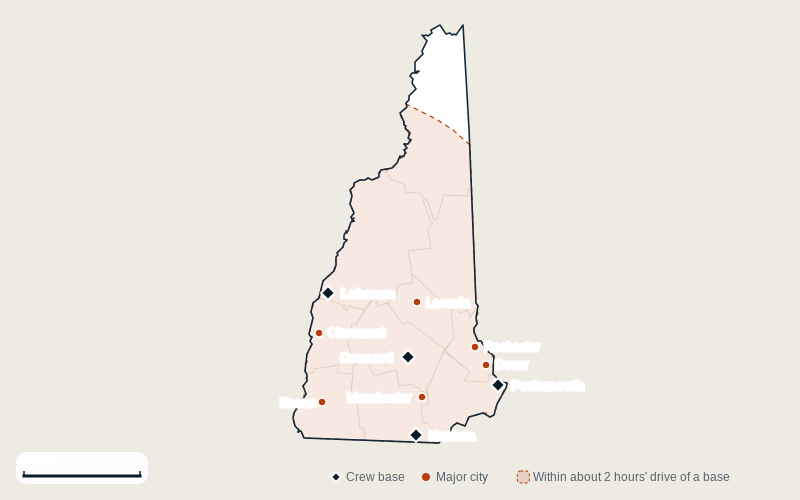
Underground Construction in the major New Hampshire metros
Crews, winter conditions and scope where we run Underground Construction most
FAQ
Underground Construction FAQ
Explains boring, burial depth, microtrenching limits and Dig Safe locate handling.
What is directional boring?
Horizontal directional drilling bores a guided pilot hole under roads, rivers, driveways, and ledge, then pulls back conduit for fiber without open trenching. Our HDD crews track depth and steering, manage drilling fluid, and daylight at handholes or building entries. It is ideal for New Hampshire crossings of Route 16, the Merrimack River floodplain, and granite-strewn yards. Trenching there would destroy walls, pavement, or septic systems.
How deep is fiber buried?
Most New Hampshire fiber goes 36 to 48 inches deep to stay below frost and plow disturbance. It needs 24 inches minimum in solid ledge where we add concrete cap or steel sleeve for protection. Drops to homes are typically 18 to 24 inches in conduit. Highways, NHDOT rights-of-way, and farm fields often require deeper cover. We set depth by soil, frost, and permit, then record as-built depths for your GIS.
What is microtrenching and is it allowed in my city?
Microtrenching cuts a narrow 1- to 2-inch slot 8 to 16 inches deep in pavement for microduct. It seals it with hot pour or grout. It is fast for downtown Manchester, Nashua, and Seacoast streets where boring is impractical. Approval varies — NHDOT restricts it on state routes and many cities require trial sections and warranties. We check city public-works rules, propose HDD or conventional trenching where microtrenching is prohibited, and guarantee sealed restoration.
Do you call 811 and handle locates?
Yes. Every underground job goes through Dig Safe 811, New Hampshire’s call-before-you-dig system. We coordinate private locates for campus, hospital, and industrial sites where 811 does not cover secondary utilities. Crews verify marks, pothole critical crossings by vacuum excavation, and maintain clearance from gas, water, and electric. We document tickets and locate photos in your closeout package for liability protection.
Do you restore lawns, sidewalks and pavement?
Yes — restoration is part of our scope, not an extra. We backfill and compact trenches in lifts, replace loam and seed or sod, and reset granite curbing and pavers. Teams patch sidewalks and asphalt to city and NHDOT specs with infrared or mill-and-overlay where required. In ski-country and Lakes Region towns we schedule final paving after frost heave season. Every address gets before-and-after photos so property owners and inspectors sign off quickly.
Related services
Frequently paired with Underground Construction
Aerial Fiber Construction
ISPs and co-ops receive storm-ready aerial spans that pass NESC inspection with documented sag, clearance, and OTDR proof.
Fiber Network Design & Engineering
Towns and ISPs get buildable routes because engineering pairs field verification, make-ready, permits, and bid-ready GIS packages.
FTTH & FTTx Construction
Homes and units activate faster with PON-designed outside plant that arrives spliced, tested, and mapped.

Start a project
Get a Fixed Fiber Price
Send drawings or route Google Earth map file (KMZ). Get itemized price, schedule window and exclusions within one business day.
Expect a planning estimate within one business day.