Installation in New Hampshire
Fiber Optic Installation in New Hampshire
We install aerial and underground fiber, building risers and campus backbones with permits and splicing. Tier 1 plus Tier 2 test proof serves carriers, towns and enterprises.

Quick answer
Fiber optic installation here covers single-mode and multimode builds for providers, towns, campuses, hospitals, and factories — aerial, drilled underground, and indoor. Most small jobs finish in one to two weeks; larger rings take longer. Price depends on footage, rock and boring, make-ready (pole prep for new attachments), permits, access, and test level.
Overview
Commercial buyers ask what a lasting build takes in this state. Operating since 2005 from Nashua, we design aerial and underground outside plant (OSP) and inside plant (ISP). Our designs handle ledge, frost, ice load, and narrow roads. Crews set strand, place self-supporting cable or lashed loose-tube, drill or trench where poles fail, and build risers with fire-stopped penetrations. Every run gets optical loss test set (OLTS) insertion-loss checks plus optical time-domain reflectometer (OTDR) traces. All-dielectric self-supporting (ADSS) spans go where power space demands isolation, never lashed. Our teams place 310+ miles yearly with a 98% first-pass acceptance rate.
Project cost follows footage, rock and horizontal directional drilling (HDD) length. It reflects pole attachments and sequencing, permits, building access, and Tier 1 or Tier 2 proof. A 24-strand lateral to one building often completes in days; a multi-mile middle-mile ring with splicing and certification runs weeks. Field supervisor Dustin Barrera (FOA CFOS/S) signs each loss budget and oversees bidirectional testing to TIA-568.3-D limits. Reviewed by Registered Communications Distribution Designer (RCDD) Diego Gentry. NH Contractor License #NH-889348 · Bonded & insured work carries a 2-year workmanship warranty plus manufacturer system warranty where certified. You receive .sor files, PDFs, splice maps, photos, labels, and as-builts in Google Earth map file (KMZ). They include CAD drawing (DWG), and PDF with photo logs within five business days.
Before you choose cable and digging method for ledge, frost, and narrow town roads, review cost and construction tradeoffs. Our comparison of copper versus fiber for enterprise and campus links explains where glass pays off. Also our breakdown of boring, trenching, and microtrenching methods shows what survives granite and freeze-thaw.
Standards we build to
- TIA-568.3-D — fiber limits, connector and splice maxima for acceptance
- TIA-526-7-A — single-mode OLTS loss method at 1310/1550 nm
- TIA-526-14-C — multimode OLTS loss method at 850/1300 nm
- National Electrical Safety Code (NESC) ANSI C2 — aerial clearances, loading, and joint-use spacing
- OSHA 29 CFR 1926 — excavation, power-line, and work-zone safety
What cable and indoor pathways are included?
You get loose-tube and ribbon single-mode backbone for middle-mile, rings, and passive optical network (PON) feeder, plus OM3/OM4 multimode for short links. We match count, bend radius, pulling tension, and slack storage to winter contraction and crowded mill risers. A recent 144-count ring in the Merrimack Valley averaged 0.04 dB per fusion splice, well under the 0.10 dB target. Slack loops and grounded entries keep later moves simple.
Inside buildings we route armored or plenum cable through tray and innerduct. It reaches main distribution frame / intermediate distribution frame (MDF/IDF) rooms with firestopped penetrations. Single-mode loss is measured per TIA-526-7-A at 1310/1550 nm; multimode per TIA-526-14-C at 850/1300 nm, with limits from TIA-568.3-D. Mated pairs must stay under 0.75 dB, with 0.3 dB typical. Tier 2 adds OTDR traces and endface images graded to IEC 61300-3-35.
How do you build aerial and underground plant in rock and ice?
Aerial routes need town and NHDOT right-of-way permits plus pole-attachment approval from Eversource, Liberty, or the co-op. We set strand, hang lashed loose-tube on a messenger, or fly ADSS where isolation helps, sized for ice and wind load. Clearances follow NESC rules over state routes, rail lines, and driveways. Make-ready sequencing is scheduled before lashing to avoid idle crews.
Underground paths avoid ledge where possible and drill where digging fails. We directionally bore under lots, rivers, and road crossings with locatable conduit, handholes, and markers, and microtrench in paved lots where towns allow. High water near rivers and lakes gets sealed closures and raised slack storage. A loss budget shows fiber kilometers times dB per kilometer plus splices, connectors, and margin for approval.
What do campuses, FTTH, and commercial sites receive?
Campuses need diverse rings, not daisy chains. We build redundant single-mode rings with laterals sized for Wi-Fi, cameras, access control, and small cells. Those rings link dorms, mills, and outbuildings through separate entries. Each building-to-building link gets surge protection, labeled panels, and winter-serviceable access. Cutovers use night or phased windows with written methods to protect classes, care, and production.
For provider and town fiber-to-the-home work we place feeder, distribution, drops, hubs, splitters, and terminals for fast activation. A 32-way split typically runs 15 to 17 dB of splitter loss before fiber and connectors. Budgets use 15 to 28 dB total link loss for planning. Closeout brings bidirectional OLTS results, OTDR .sor traces, maps, and photos. Grants and carrier acceptance clear easily without retesting.
Installation in New Hampshire: what's different here
Granite changes everything from the Merrimack Valley to the North Country. Ledge near the surface forces boring over trenching, frost heave lifts shallow handholes, and ice loads size strand and lashing. Mud-season postings close town roads to heavy reels. Foliage season clogs traffic on resort routes, and shoreland rules near big lakes shape drilling fluids and dewatering. We sequence ski-area and leaf-season work around traffic. Then we coordinate NHDOT districts and selectboards and align town broadband plans with Broadband Equity, Access, and Deployment (BEAD) guidance. Send route KMZ, address list, and drawings to receive a budgetary number, schedule window, and assumptions within one business day.
Who hires us
Customers we serve with Installation
Granite ledge and ice loading punish poorly lashed spans. electric utility broadband teams hire us for fiber optic installation built for co-op substations and wooded rights-of-way.
Colocation halls need verified polarity and labeled pathways from day one. So data center operators planning new builds rely on us for fiber optic installation with documented test results.
Dormitory quads and science halls complicate routing during the school year. campus technology leaders upgrading networks call our crews for fiber optic installation phased around classes and breaks.
ISPs & Telecom Carriers
Carrier-grade fiber-to-the-home (FTTH), middle-mile, and last-mile builds for ISPs and telecom carriers, with aerial, underground, splicing, and NOC-ready testing across New Hampshire.
Electric Utilities & Cooperatives
Utility fiber construction, all-dielectric self-supporting (ADSS), optical ground wire (OPGW) support, underground, and supervisory control and data acquisition (SCADA) links for electric utilities and cooperatives built for ice, wind, and granite ground.
Data Centers
High-density inside-plant, cross-connects, and diverse entrance fiber for colocation and enterprise halls, certified for low loss and polarity with usable records.
Government & Municipal Broadband
Open-access backbone, town-wide distribution, and transportation fiber for municipalities and agencies, from design and permits through testing and handoff records.
Benefits
Why owners pick us for Installation
Built for Ledge, Frost, and Thaw
Frost sleeves, ice-rated hardware, boring plans for shallow rock, and spring load-limit scheduling keep reels moving. This continues when town roads post limits and temps drop below zero.
One Foreman From Pole to Panel
OSP construction, indoor risers, fusion splicing, and OLTS plus OTDR proof stay under one lead. Boring crews, electricians, and test techs never trade blame.
Numbers Carriers Accept
Bidirectional insertion-loss data, .sor traces, endface images, and KMZ as-builts satisfy reviewers on first submission. They include carrier, town, and grant reviewers and speed final light-up for FTTH, middle-mile, and campus builds.
Work Without Stopping Operations
Night and phased cutovers, dust control, and written step plans let hospitals, schools, and plants keep running. Risers, panels, and drops go live safely.

Process
Our installation process
Walkdown and Engineering
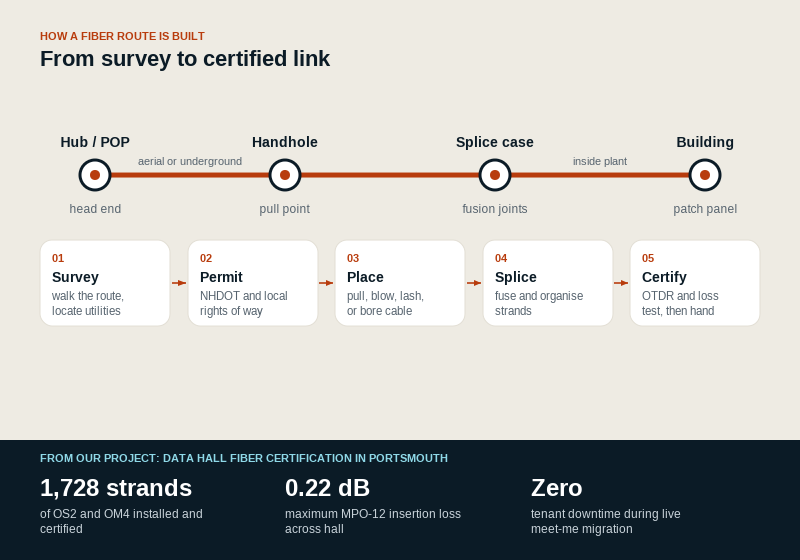
We survey poles, ledge, wetlands, and risers. You receive a marked route, cable counts, splice points, and loss budget for approval with photos and access notes included.
Permitting and Make-Ready
We file town and NHDOT permits and coordinate attachments. You get a clear schedule, pole list, and traffic plan before digging starts with weekly updates until release.
OSP and ISP Construction
Crews place conduit, pull or lash cable, and set racks and enclosures. You receive daily progress photos, tension logs, and marked changes with supervisor sign-off each evening.
Splicing and Termination
Techs fuse, terminate, clean, and inspect glass. You get tray maps, connector images, and splice-loss tables as work closes for every closure and panel location.
Test, Map, and Turn-Up
We certify links, label fibers, and deliver .sor files, PDFs, and KMZ as-builts. Then we join carrier checks until circuits light correctly with closeout inside five business days.
Proof
Installation projects we've delivered

Resort Fiber Backbone in Hampton Beach
We built a resort-wide fiber backbone and certified telecom rooms for a Hampton Beach hospitality property. It replaces failing copper with armored single-mode and laser-optimized multimode (OM4) to carry peak-season traffic.

Data Hall Fiber Certification in Portsmouth
Data center operator at Pease Tradeport added 1,728 strands of single-mode (OS2) and OM4 with diverse entrances. It hit 0.22 dB max multi-fiber push-on (MPO) loss and zero tenant downtime.

Hospital Campus Fiber Ring in Manchester
Regional hospital network in Manchester received a 12-mile diverse fiber ring linking three buildings across two Merrimack crossings. Failover verified under 50 ms with zero clinical downtime.
Learn more
Articles on installation
Areas we serve
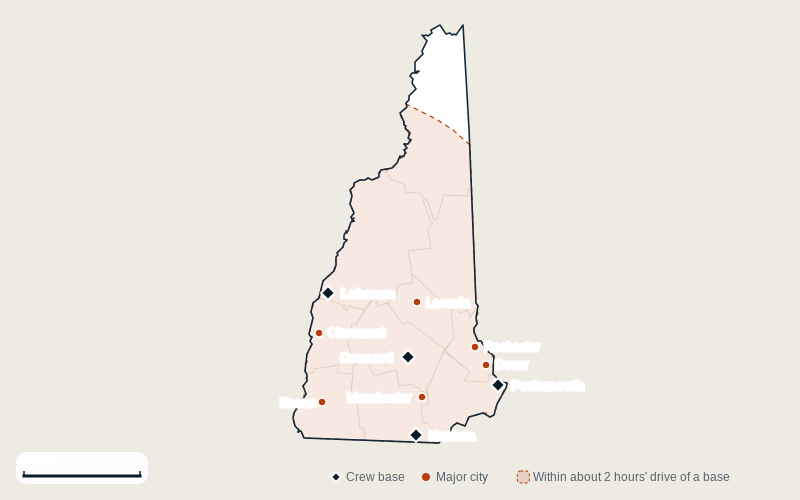
Installation in the major New Hampshire metros
Crews, winter conditions and scope where we run Installation most
FAQ
Installation FAQ
Covers per-foot cost, timelines, fiber choice and building-to-building runs.
How much does fiber optic installation cost per foot in New Hampshire?
In-building runs often fall in the low single digits per foot plus terminations and testing. OSP ranges widely with rock, boring, and make-ready. Ledge drilling around Laconia or the White Mountains costs far more than open trench in the Merrimack Valley. We price after a walkdown with a line-item estimate for conduit, cable, splicing, and certification.
How long does a fiber installation take?
A single building backbone can finish in days, a multi-building campus in two to six weeks, and miles of FTTH or middle-mile in months with permitting. NHDOT, town ROW, and pole make-ready often control the schedule. We provide a phased timeline with night work options for hospitals, schools, and manufacturers.
Should I use single-mode or multimode fiber?
Use single-mode OS2 for building-to-building, campus, FTTH, and any run over 500 feet or needing 10G+ growth. Use OM4/OM5 multimode for short in-building data-center and backbone links where optics cost matters. Many New Hampshire campuses use single-mode between buildings and multimode inside for flexibility.
Can you run fiber between two buildings on my property?
Yes. We commonly link offices, barns, dorms, clinics and warehouses in places like Lebanon, Keene and Dover. Armored underground or aerial cable, proper grounding and lightning protection and diverse entries protect them. We handle easements, NHDES crossings if wetlands intervene, conduit, splicing, and full OTDR certification.
Will I get test results and as-builts after install?
Yes. Every project closes with bidirectional OTDR and OLTS files. It also includes endface inspection images, panel schedules, and photos. GIS or CAD as-builts show handholes, splice points, and depths. That packet supports carrier acceptance, manufacturer warranty, municipal records, and future troubleshooting without re-digging to find plant.
Related services
Frequently paired with Installation
Fiber Optic Splicing
Certified splicers fuse single-fiber and ribbon plant and verify each joint with bidirectional traces for steady winter performance.
Fiber Optic Testing & OTDR Certification
Owners receive defensible acceptance proof because our crew certifies every strand with calibrated Tier 1 and Tier 2 testing.
Data Center & Structured Cabling
Our team builds tested high-density backbones and neat distribution rooms. Data halls stay ready for 100G and 400G growth.

Start a project
Get a Fixed Fiber Price
Send drawings or route Google Earth map file (KMZ). Get itemized price, schedule window and exclusions within one business day.
Expect a planning estimate within one business day.